Post-purchase experience playbook: Tracking, returns and retention

 Delivery
Contents
- What is the post-purchase process experience?
- What are the 7 stages of the post-purchase experience?
- Why post-purchase experience matters
- Why you may have a bad post-purchase experience
- How to create a seamless post-purchase experience and loyal customers
- How to measure post-purchase experience success
- Post-purchase experience checklist
- FAQs
A customer orders three items, but they ship in two parcels. The first arrives on Tuesday, and the tracking page says “delivered.” The customer has no idea whether the other items are still coming, so they contact support.
Nothing has gone wrong with the order. The problem is that the customer can’t see what’s happening. Gaps like this can turn an otherwise successful purchase into a frustrating experience.
This guide explains what the post-purchase customer experience includes, why it matters and how to improve each stage, from order confirmation to returns and repeat purchases.
What is the post-purchase process experience?
The post-purchase experience refers to every interaction a customer has with your brand after placing an order, from confirmation and delivery tracking to returns, support and the decision to buy again. It includes operational processes, such as fulfillment, and customer-facing interactions, such as shipping notifications.
It’s more than shipping or customer service interactions. A customer might receive an order on time but still have a bad experience if they can’t exchange an item or find out exactly when their refund will arrive.
The immediate post-purchase phase ends once the order and any related issues are resolved. But the customer’s experience can affect their next-purchase decision and the longer brand-customer relationship.
Post-purchase experience vs. post-purchase customer journey and post-purchase behavior
These terms are connected, but not interchangeable.
| Term | Meaning | Example |
|---|---|---|
| Post-purchase experience | How customers perceive their interactions | “I knew when my order would arrive, and returning it was easy.” |
| Post-purchase customer journey | The sequence of interactions after checkout | Confirmation → tracking → delivery → review request |
| Post-purchase behavior | What customers do after buying | Checking tracking, contacting support or reordering |
Map the post-purchase customer journey to understand each touchpoint, then study post-purchase behavior to see how customers respond. Post-purchase evaluation helps you see whether the whole process met their expectations.
What are the 7 stages of the post-purchase experience?
Think of each stage of the customer’s post-purchase experience as a question that needs answering. Your job is to keep customers informed, ideally before they ask, without spamming them with endless notifications.
| Stage | Customer question | Retailer responsibility | Example touchpoints |
|---|---|---|---|
| 1. Order confirmation | Did my order go through? | Confirm the order, set delivery expectations and provide extra guidance for first-time buyers where needed. | Confirmation page, personalized email |
| 2. Processing and fulfillment | Has anything happened yet? | Explain dispatch timing and changes, tailoring communication to the order and customer segment. | Personalized pre-dispatch updates |
| 3. Shipping and tracking | Where is my order? | Show the full order in understandable statuses and tailor tracking communications to customer preferences. | Branded tracking page, email, SMS |
| 4. Delivery and exceptions | Will it arrive as expected? | Explain delays or failed deliveries early, with relevant updates based on the customer’s situation. | Proactive delay alert, delivery notification |
| 5. Returns and issue resolution | What if something is wrong? | Make exchanges, returns and support straightforward, with eligible return options tailored to customer segments, policies and risk levels. | Personalized returns portal, support |
| 6. Post-delivery engagement | What happens now? | Provide relevant product guidance, recommendations and offers based on purchase history, customer segment and order status. | Product tips, personalized recommendations, review request |
| 7. Feedback and next purchase | Should I shop here again? | Learn from feedback and encourage repeat purchases with relevant follow-ups for first-time and loyal customers. | Survey, loyalty offer, personalized post-purchase marketing |
Personalization matters throughout the post-purchase journey. A first-time buyer might need more reassurance about delivery and returns, while a VIP customer may qualify for different return options or loyalty benefits. The goal is to give each customer the right experience at the right time. This requires control over customer segments, communication rules and post-purchase journeys rather than sending everyone through the same process.
Fast delivery doesn’t guarantee a positive post-purchase experience. Customers also need accurate expectations, clear communication and an easy way to resolve problems.
Why post-purchase experience matters
- Customer retention and lifetime value. In Sifted’s 2025 consumer survey, 76% of shoppers said a positive delivery experience influenced their decision to buy from a brand again. Repeat purchases increase customer lifetime value (CLV). One-time buyers can become brand ambassadors, and word-of-mouth marketing will get you more new customers, so treat every first order as affecting future revenue and customer loyalty.
- Customer service pressure. When online shoppers can’t find an estimated delivery date or understand a tracking status, they contact the customer support team. Better post-purchase communication can reduce “Where is my order?” (WISMO) requests and free up customer service agents to handle more complex inquiries.
- Revenue retained through returns. The NRF and Happy Returns 2025 report estimated that 19.3% of annual online sales would be returned. An easy returns process can protect post-purchase satisfaction, while appropriate exchange offers or store credit can retain revenue that would otherwise be refunded.
- Branded tracking pages for better post-purchase engagement. Customers often check their order status several times before delivery. If they’re redirected to a carrier’s website, you lose those opportunities to engage with them. A branded tracking page keeps customers on your website, where they can find order updates, access support and discover relevant products. This gives you more opportunities to encourage repeat purchases while keeping the experience consistent with your brand.
- Data to reduce recurring problems and costs. Tracking delivery performance, return reasons and customer feedback helps you identify problems that have negative post-purchase experience effect. For example, if one carrier regularly delivers late in a particular region, you can investigate the cause and make changes to reduce delays. This means fewer customer complaints, lower support costs and a better experience for future customers.
Why you may have a bad post-purchase experience
Even when orders arrive on time, customers can still have a frustrating experience if post-purchase interactions are unclear or help is hard to find. Here are some of the most common problems retailers should address:
- No updates between checkout and shipping. Customers receive an order confirmation but don’t know when their purchase will ship. Without updates, they may worry something went wrong and contact support unnecessarily.
- Customer service teams lack complete order information. When customers ask about a missing item or delayed delivery, support agents may not have access to the latest warehouse or carrier information. This makes it harder to provide accurate answers and resolve customer inquiries quickly.
- Late communication about delivery problems. Customers learn about delays only after the expected delivery date has passed or after they contact support. Earlier notifications could help them adjust customer expectations, be more forgiving about delays and avoid unnecessary inquiries.
- Incomplete tracking information. When an order ships in several parcels, customers may see only one shipment’s status. If that parcel is marked as delivered, they may assume the remaining items are missing.
- Complicated returns and unclear refund timelines. Customers struggle to find return instructions, need to contact support to request a label or can’t check when their refund will arrive. These extra steps make an already inconvenient situation more frustrating.
- Irrelevant, excessive or conflicting post-purchase communication. Customers receive review requests or promotional offers while dealing with a damaged product or unresolved return. They may also receive conflicting delivery updates or too many notifications from both the retailer and the carrier, leaving them unsure which information to trust. Poorly coordinated communication can create confusion and frustration, weakening customer trust and brand loyalty.
Poor post-purchase experiences like these can increase support tickets and damage your brand reputation, even when orders arrive successfully. This can lead to customer churn, higher costs from inefficiencies and stagnant growth.
How to create a seamless post-purchase experience and loyal customers
Improving the post-purchase experience can be difficult when order information, carrier updates and returns data are spread across different systems. Customers may struggle to find accurate information, while your teams spend time resolving customer support tickets that could have been avoided.
You need post-purchase experience software. parcelLab is a post-purchase experience platform that helps eCommerce retailers manage the customer journey from checkout through delivery, returns and beyond. It connects order, shipping and returns data so you can give customers a branded tracking page, send proactive delivery updates and offer self-service returns. Your teams can also use this information to identify recurring problems and improve performance.
The platform has four main pillars: Convert helps you set delivery expectations before checkout, Engage manages tracking and customer communication, Retain handles returns and exchanges, and Insights reports on post-purchase performance.
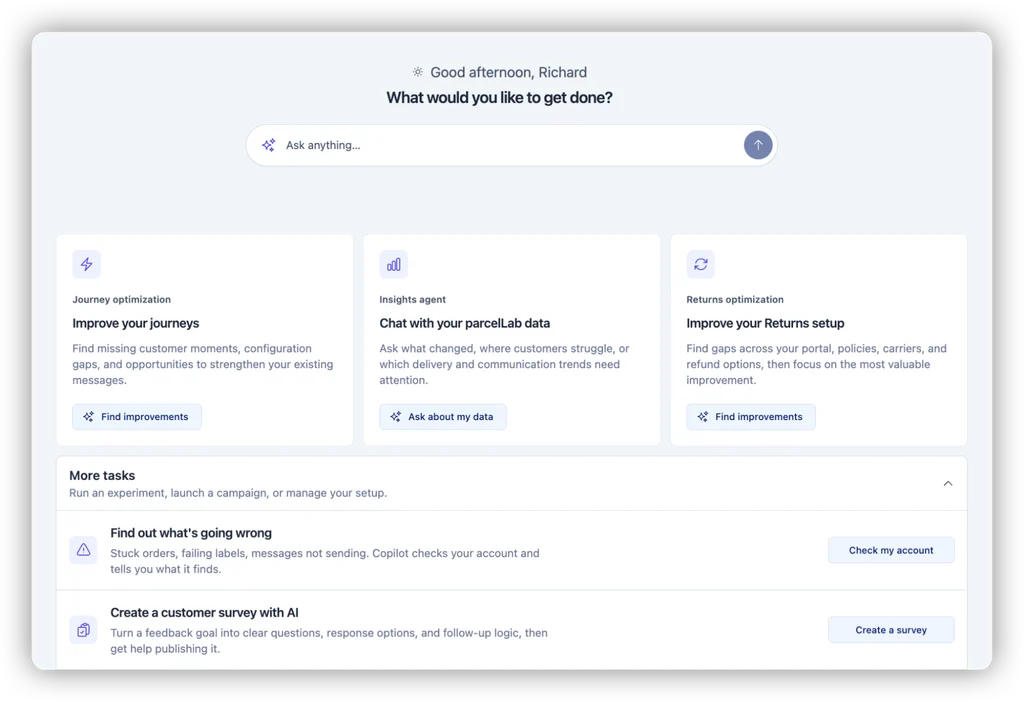
Let’s look at eight practical ways to improve every post-purchase stage, and how parcelLab can help with each.
1. Map your post-purchase journey and identify gaps
Review recent orders that arrived on time, were delayed or were returned. Compare the information available in your systems with the messages customers actually received. Did a parcel stop moving without triggering an alert? Did customers have to contact support for an update?
With parcelLab Copilot, you can investigate missing tracking updates, review your communication setup and identify gaps in your existing journeys.
For each problem, decide what customers should receive, which team has the information and how you’ll measure the communication improvement. The table below shows a few examples of how to map customer events to the right messages, responsible teams and KPIs. Your actual post-purchase journey will include many more events depending on your fulfillment processes, delivery scenarios and returns workflows.
| Customer event | Available data | Customer message | Responsible team | KPI |
|---|---|---|---|---|
| Waiting for dispatch | Warehouse status | Dispatch estimate or delay update | Operations | Pre-dispatch WISMO contacts |
| Split shipment | Tracking for each parcel | Status of the full order | Ecommerce | Missing item inquiries |
| Delivery delayed | Carrier data, revised ETA | Proactive delay notification | CX and logistics | Contacts per delayed order |
| Return requested | Order and return information | Return instructions and updates | Returns team | Return status inquiries |
2. Set accurate delivery expectations
Check whether the delivery dates shown at checkout reflect your actual fulfillment and carrier performance.
With parcelLab, you can display predicted delivery dates based on factors such as warehouse operating hours, holidays and weather. Repeat the estimate in the order confirmation and notify customers if it changes.
Use Insights to compare promised dates with actual deliveries. If certain routes regularly miss their estimates, investigate the cause and adjust your delivery promises accordingly.
3. Give customers branded, order-level tracking
Split shipments and delivery exceptions can confuse customers. They shouldn’t have to check several carrier websites to find out where their order is. Offer a branded tracking page that shows the complete order, including items shipped separately.
parcelLab’s Order Status Page displays multiple shipments under one order and translates carrier updates into consistent, understandable statuses. Customers can see what’s arrived, what’s still on the way and when to expect the remaining items.
4. Notify customers before they contact support
Identify the delivery problems that generate the most WISMO inquiries, such as missed delivery attempts or parcels that haven’t moved for several days. Then set up notifications that explain what’s happening and what customers should expect next.
With parcelLab Messages & Journeys, you can configure event-triggered notifications through email, SMS and other supported channels. Trending Late identifies shipments likely to miss their delivery date so that you can notify customers earlier.
You can also ask Copilot to draft a notification and its sending rules for your approval. For example, you could request a delay alert for orders without carrier movement for 48 hours.
5. Make returns and exchanges easier
Check how many steps customers need to complete to return a product. In a smooth post-purchase experience setup, they should be able to check eligibility, choose a return option and track its progress without contacting support.
parcelLab’s self-service returns portal lets customers register returns with labels or QR codes. With Retain, you can configure return policies by market, product category or return reason and offer exchanges or store credit where appropriate.
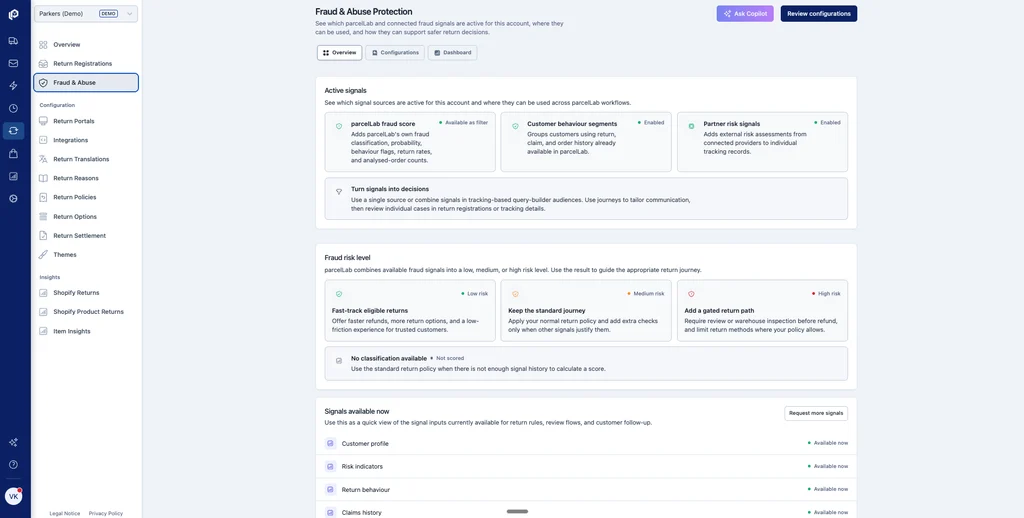
Fraud & Abuse Protection also lets you adjust workflows based on risk signals. For example, eligible low-risk returns can proceed with fewer manual checks, while suspicious requests can require additional review. These rules must respect applicable consumer rights.
6. Personalize messages based on the actual order
Review your post-delivery communications to ensure they’re relevant and appropriately timed. Not every customer needs the same post-purchase experience. First-time buyers may appreciate more detailed delivery updates and clear return instructions, while loyal customers might respond better to personalized rewards or relevant product recommendations. Timing matters too. Someone who has just requested a return shouldn’t receive repeated promotional offers or a request to review the product.
With parcelLab Engage, you can personalize automated messages based on order events and customer segments. You can also include relevant product recommendations in shipping notifications and test different messages to see which perform better.
This makes your post-purchase marketing, post-purchase upselling and other post-purchase engagement activities more relevant to each customer’s situation.
7. Give support teams access to complete order information
When customers report missing items or delayed refunds, your support agents should be able to see the relevant order, tracking and return information without contacting other departments.
parcelLab integrates with commerce and customer service systems such as Shopify, Zendesk and Salesforce Service Cloud, helping teams work with consistent post-purchase information.
Copilot can also help investigate missing carrier checkpoints or incorrect tracking statuses, so teams can identify the source of a problem instead of manually checking multiple systems.
Make sure access to customer information is appropriately controlled. parcelLab’s platform holds an independently assessed ePrivacyseal EU, reflecting our commitment to data protection.
8. Use feedback and performance data to make improvements
Collect customer feedback after delivery or return resolution, then compare it with your operational data to identify recurring problems.
With parcelLab’s post-purchase analysis features, you can review carrier performance, delivery delays and return patterns to improve future experiences and make it easier to retain customers. Copilot makes this easier by letting you ask questions in plain language, such as “Why did UK returns increase last week?” or “Which carrier has the highest delay rate?”
You can then investigate likely causes and decide what to change. For example, repeated size-related returns may justify updating a product’s size guide, while consistently late deliveries may require changes to carrier arrangements or delivery estimates.
Measure the results afterward to see whether your changes reduced complaints, support inquiries or returns.
Case study: How Wyze reduced WISMO inquiries by 20%
Smart home technology brand Wyze struggled with post-purchase communication, particularly when orders shipped in multiple parcels. Customers sometimes received one package without knowing when the remaining items would arrive, leading to confusion and unnecessary support inquiries. The company also discovered that its previous provider had stopped sending post-purchase emails for nine months due to a technical error.
With parcelLab, Wyze introduced personalized delivery notifications that keep customers informed about individual shipments and their entire order status. They also implemented proactive delay alerts, relevant product recommendations based on purchase history and a self-service returns portal.
As a result, Wyze reported a 20% reduction in WISMO inquiries, helping reduce pressure on customer support while giving shoppers clearer information throughout the post-purchase journey. This shows how better communication, personalization and connected returns workflows can improve the customer experience while reducing operational costs.
How to measure post-purchase experience success
Customer satisfaction scores can tell you whether shoppers are happy, but they won’t necessarily explain why (or why not). The following metrics can help you identify specific problems throughout the post-purchase period and measure the impact of your improvements.
| Metric | What to look for and how to use it |
|---|---|
| WISMO contacts per order | Compare inquiries before dispatch, during shipping and after the promised date. High volumes at a particular stage may indicate missing or unclear updates. |
| Repeat contact rate | Check which issues lead customers to contact support multiple times. This may reveal incomplete answers, unresolved delivery problems or poor follow-up. |
| On-time delivery and promise accuracy | Compare promised and actual delivery dates by carrier, region and shipping method. Use recurring gaps to improve delivery estimates or investigate carrier performance. |
| Delivery exception rate | Identify which carriers, routes or fulfillment locations generate the most delays and failed deliveries. Prioritize recurring causes rather than isolated incidents. |
| Tracking page engagement | Measure tracking page visits and repeat visits alongside WISMO inquiries. Frequent checks combined with high support demand may indicate that customers can’t find the information they need. |
| Return rate by reason | Look for recurring complaints about sizing, quality or product descriptions. Use these patterns to address avoidable returns. |
| Exchange vs. refund rate | Track how often eligible returns become exchanges instead of refunds. Low exchange rates may indicate limited replacement options or poor availability of alternative sizes. |
| Return processing time | Measure how long each step takes, from return registration to completing a refund or exchange. Identify delays that generate unnecessary support contacts. |
| Repeat purchase rate | Compare customers who experienced delays or returns with those whose orders went smoothly. Look for differences in retention over comparable periods. |
| Customer feedback by journey stage | Compare feedback after delivery, returns and support interactions. Investigate recurring complaints alongside operational data to find their causes. |
With parcelLab Insights and Copilot, you can investigate these patterns across your post-purchase data and identify where to make changes.
Post-purchase experience checklist
Use this checklist to see where your current processes can be improved:
- Order confirmations arrive immediately.
- Delivery expectations are clear before and after checkout.
- Customers can track orders on a branded page.
- Split shipments show which items are still on the way.
- Delays trigger proactive updates.
- Eligible returns can be started without contacting support.
- Support agents can see the full order context.
- Post-delivery messages reflect the order’s actual status.
- Teams use consistent tracking information.
- Customer feedback and performance results inform future improvements.
If you need clearer tracking, timely communication and more control over returns across multiple markets, parcelLab can help you coordinate those experiences through connected order data and configurable journeys.
Book a demo to see how it could work with your existing systems.
FAQs
It shapes whether customers trust you with another order. Accurate updates and convenient issue resolution build loyalty and encourage repeat business, increasing retention, boosting customer lifetime value and supporting word-of-mouth marketing.
Identify gaps in your customer journey, then address them with accurate delivery estimates, branded tracking, proactive updates and self-service returns. Personalize messages based on order status and give support teams access to complete order information. Use parcelLab Insights and Copilot to analyze customer feedback and performance data, identify recurring problems and measure improvements.
Complicated returns, delayed refunds and unreliable customer support can frustrate customers and discourage repeat purchases. Clear return policies, self-service options and timely updates make the process easier. When appropriate, offering exchanges or store credit instead of refunds can also help retailers retain revenue and encourage customers to shop again.
It connects order, carrier and return information to support branded tracking, delivery notifications and returns. Platforms such as parcelLab also offer performance analytics, helping retailers identify recurring problems and improve future customer experiences.
Everything on Post-purchase experience
- Most brands check out at checkout: 8 ways to increase post-purchase engagement
- Post-purchase behavior: Your path to higher customer lifetime value
- Post-purchase communication: Best practices, channels and examples
- Why post-purchase is fashion’s hidden growth engine in a slowing market
- NRF ’26 recap: How True Classic built a post-purchase journey that never ends
- The modern man’s journey: From rugged to refined
- Revolutionizing CX for the modern man: Lessons from Jackson and Dr. Squatch
- Mastering omnichannel CX: Lessons from Wyze and Olly Vitamins
- How customer experience teams can elevate everyday basics: Insights from True Classic and Tommy John
- How to create perfected post-purchase ‘vibes’ for Gen Z
- Introducing the PPX Maturity Curve: Elevate your post-purchase experience
- [Podcast] Post-Purchase Success: How to map the modern customer journey
- [Podcast] Post-Purchase Success: Jana Soppa, parcelLab’s Head of Carrier Integration
- What is direct to consumer (DTC)?
- How to Improve the Customer Experience in Ecommerce
- Luxury Brands Ecommerce Experience Guide: How to Create High-End Shopping Experiences Online
- What is Post-Purchase Evaluation?
- Guide to Luxury Brands Post-Purchase Experience
- What’s the Post-Purchase Customer Journey? Everything You Need To Know
- Hotel Chocolat puts customers first post-purchase
- Health and Beauty: A guide to post-sales communications
- UK Operations Experience Study 2021 Key Findings: Checkout
- 5 Operations Experience issues e-commerce brands must fix
- Customer Experience Trends – Amazon, Amazon and more…Amorelie
- Post-sales experience – one size doesn’t fit all
- 7 post-sales experience recommendations for fashion brands
- Customer Experience Trends – DHL no longer delivers via cash on delivery
- Lidl adds more innovation to post-purchase communications with a Facebook Messenger Chatbot
Liked this Post? View more related posts below