 Comparisons
Transform your post-purchase experience today

Malomo and parcelLab both give online retailers branded order tracking and proactive delivery notifications. Malomo is built for Shopify brands that want polished tracking pages fast. But if you need to manage returns, a second store or a new market, it may not be enough. parcelLab covers the whole post-purchase journey in one platform, from delivery promises before checkout to returns and fraud rules. Here’s how they compare.
| Feature | Malomo | parcelLab |
|---|---|---|
| Product scope | Branded order tracking pages, delivery notifications and shipment analytics for Shopify brands | One post-purchase platform: delivery promises, tracking, notifications, returns, fraud rules and analytics |
| Delivery estimates | Shows the carrier’s own delivery date; no date for parcels tracked through its add-on network of extra regional and international carriers | Predicts its own delivery date and shows it on product pages and at checkout; reports how often that date was met; flags parcels likely to arrive late |
| Returns model | Connects to returns apps such as Loop and Corso; parent company Redo sells its own returns products | Built-in returns management: embedded portal, refunds, exchanges, store credit, risk-based rules, warranty and cross-border returns |
| Data integrations | Shopify and Shopify Plus; public API and webhooks; apps such as Klaviyo, Attentive, Postscript and Gorgias | Shopify, Magento 2 and Shopware apps; API, file transfer or event bus; marketing and support tools |
| Pricing model | Published plans by shipment volume, with overage and per-email fees; month-to-month | Custom quote based on modules, shipment volume and users |
| Customer support | Email, chat and knowledge base; concierge onboarding and dedicated support on the top plan | Dedicated customer success manager as standard; 4–8 week standard implementation; teams in the US and Europe |
| Fraud controls | No native fraud scoring or return-policy controls in Malomo’s tracking product; parent company Redo offers AI-powered return risk scoring and fraud rules | Order and customer risk scoring; configurable return eligibility, windows, refund timing, compensation options, verification and manual review based on risk |
| Claims management | Tracking pages provide shipment visibility and a missing-package help prompt; claims resolution relies on connected systems, such as Redo, or retailer support workflows | Branded self-service claims for missing, delivered-not-received and damaged packages; configurable eligibility, evidence collection, carrier-compliant records and reporting |
| Predictive AI and agents | Rule-based problem-order detection; AI-powered return reviews available through parent company Redo | Machine-learning delivery estimates and delay predictions, return-volume forecasts and an AI agent for order- and return-status inquiries |
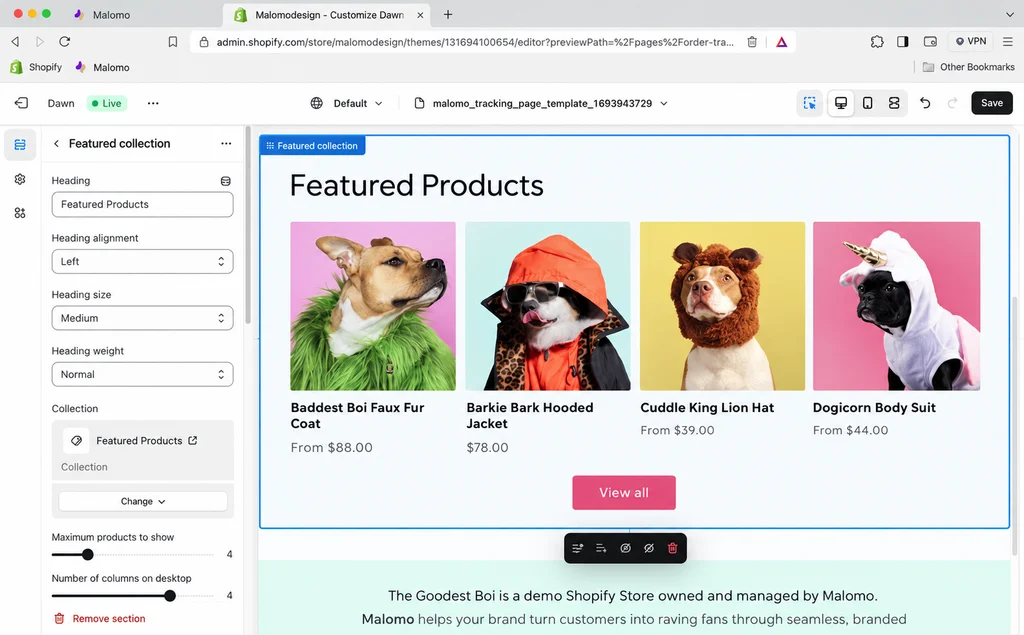
Malomo was built around Shopify. You add its tracking page to a Shopify theme as an app block, create as many tracking pages as you like, and show split shipments within one order. Headless storefronts can use Malomo’s JavaScript library, using your own development resources. Malomo’s team can also build the page for you, in your theme or hosted by Malomo.
parcelLab’s branded tracking pages embed in any website, Shopify or otherwise, so brands with several stores or commerce systems can present one tracking experience. The page supports 25+ languages, shows purchased items, campaign banners and your product recommendations, and groups every package that belongs to the same order.
Malomo sends branded transactional emails directly, for a per-message fee, or passes tracking events to the marketing tools Shopify brands frequently use, including Klaviyo, Attentive, Sendlane and Postscript. Ready-made Klaviyo flows let your team design delivery emails in its existing email platform.
parcelLab sends customer communications via email, SMS, push notifications, or WhatsApp, and can also route messages through Klaviyo or Postscript. You can organize messages by shop or market and choose the delivery events and order details that trigger each one. You can A/B test email variants before rollout.
Result: After a Black Friday communications failure pushed WISMO calls to 27% of contacts, Caraway decided to try parcelLab. The cookware brand now sends proactive delay updates, with an automatic gift card when an order runs late. WISMO calls fell to 10% of customer service contacts. When Caraway asked for an automatic email once a refund was issued, parcelLab built it based on that feedback.
Malomo tracks multiple carriers across two networks. Its standard network needs your own credentials for some major carriers, and an extended network adds regional and international carriers, free on some plans and charged per shipment on others. Shipments on the extended network show no estimated delivery date in notifications or on the tracking page, only a link to the carrier’s site. For exceptions, Malomo flags stalled orders using detection rules you can adjust.
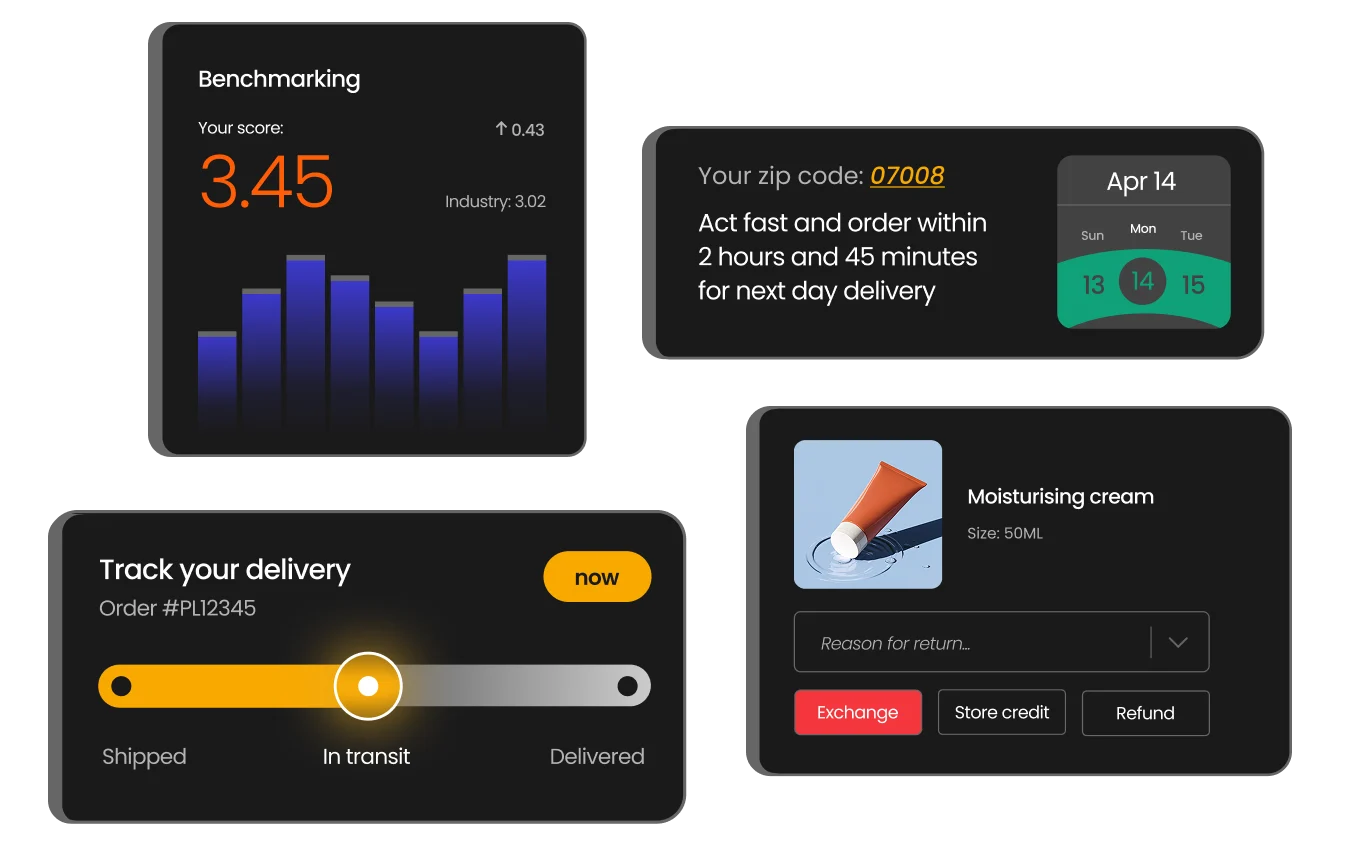
parcelLab connects with 450+ carriers through each carrier’s own interface and standardizes the tracking data, so delivery information reads the same across carriers. Its delivery promises show an estimated delivery date before checkout, calculated for the shopper’s postcode. Without a postcode, the estimate is based on their country. The promised date is stored, so you can measure delivery performance and carrier performance against what customers were told. After dispatch, parcelLab flags late parcels and triggers a message before WISMO tickets arrive.
Malomo focuses on branded tracking rather than processing returns within its core product. It connects to returns apps such as Loop and Corso. Since its acquisition by Redo, retailers can also access a wider offering that includes returns, exchanges, fraud detection and claims management. The available functionality depends on which products you choose.
parcelLab provides a self-service returns portal embedded on your website. Shoppers can request refunds, exchanges or store credit, while you control return eligibility by product, market or customer segment. The platform also supports warranty returns, partial-refund keep-it offers and cross-border returns.
With parcelLab’s Fraud & Abuse Protection, you can score risk using order history, return behavior and other fraud signals. Risk levels determine return eligibility, refund timing, compensation options and approval requirements. For example, trusted shoppers can receive instant refunds, while high-risk requests require additional verification or manual review.
parcelLab also offers claims management for missing, delivered-not-received and damaged packages. Customers submit claims through a branded self-service experience, with eligibility rules, waiting periods and evidence requirements you define. Your team gets structured claim records with tracking events, order details and supporting documents for carrier submissions.
Malomo pulls order data from Shopify and offers a public API and webhooks for other systems. Its dashboards show carrier performance, fulfillment and transit times, problem orders and tracking-page revenue attribution, with weekly performance emails. Parent company Redo also offers AI-powered returns, claims and customer support capabilities.
parcelLab accepts order data through its API, file transfer or an event bus, with ready-made integrations for Shopify, Magento 2, Shopware and customer support tools. Its reporting covers delivery performance, customer communications and returns, including industry benchmarks and SKU-level analysis.
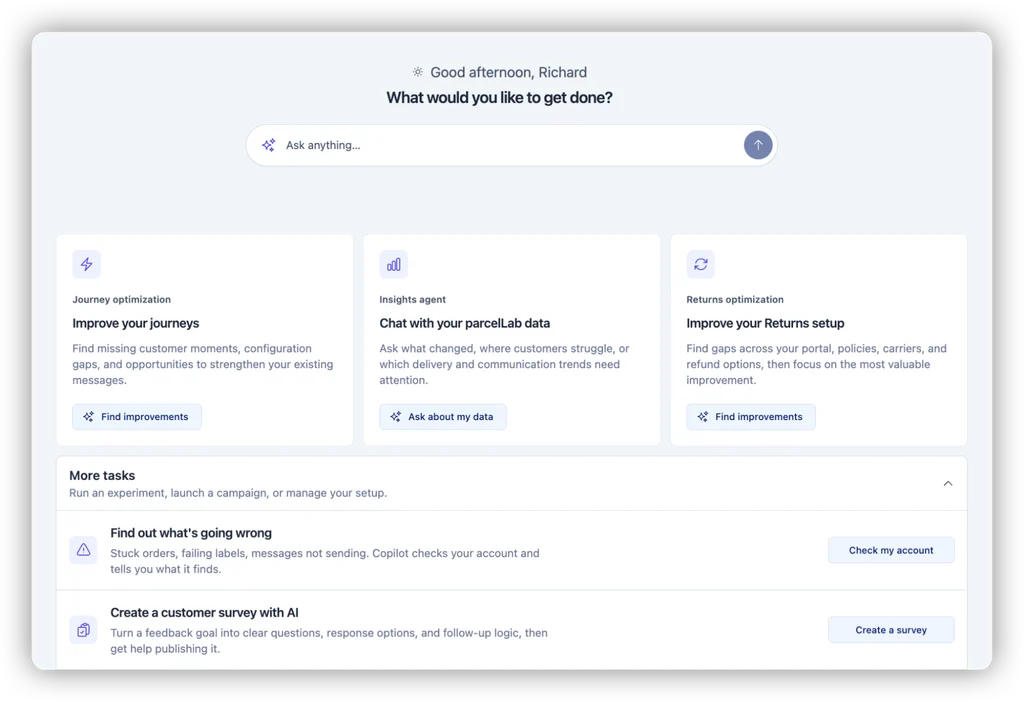
parcelLab Copilot goes beyond answering questions about your data. The in-app AI assistant can investigate delivery exceptions, create messages and customer journeys, configure return policies, audit existing workflows and troubleshoot tracking or integration issues.
For example, you can ask Copilot to extend return windows for holiday orders, create a delay notification for shipments without carrier updates or investigate why return labels aren’t generating in a particular country. Copilot checks your existing setup, prepares the changes and shows you what will be affected. Your team reviews and approves changes before they go live.
Beyond Copilot, parcelLab uses machine learning to predict delivery dates, identify shipments likely to arrive late and forecast return volumes. The WISMO/R Agent can also answer customer questions about orders and returns using live tracking data, with escalation to support teams when needed.
Malomo plans are based on monthly shipment volume, with fees for extra shipments and directly sent emails, and contracts run month to month. Entry plans can be live in minutes with email and chat support and unlimited user access. The top plan adds concierge onboarding, Malomo-built tracking pages and dedicated support.
parcelLab pricing is a custom quote based on the modules you choose, your shipment volume and your number of users. Every customer gets a dedicated customer success manager, a standard implementation takes four to eight weeks, and support teams are based in the US and Europe.
The right platform depends on how much of the post-purchase journey you want in one place. Mid-market brands often have complex return rules, while some large enterprises need only a tracking page.
Malomo is a solid choice for Shopify brands that want branded tracking pages live within days, already run returns in Loop or Redo, and manage customer engagement in Klaviyo or Attentive.
parcelLab is a better fit if you need delivery promises before checkout, branded tracking and returns across multiple markets, or more control over fraud and claims management. It’s also worth considering if your team wants AI assistance for investigating issues, configuring workflows and managing the post-purchase experience without relying on developers for every change.
Make migration easier with these four steps:
Tracking pages are only the start of the post-purchase experience. Book a demo to see delivery promises, branded tracking and returns management working together in parcelLab.
Malomo focuses on branded tracking and delivery notifications for Shopify brands, with access to additional returns, claims and AI capabilities through parent company Redo. parcelLab provides delivery promises, tracking, communications, returns, fraud controls and claims management in one platform, with Copilot helping teams investigate issues and configure workflows across the post-purchase journey.
Malomo’s native commerce integration is Shopify and Shopify Plus. Headless storefronts can add its tracking pages through Malomo’s JavaScript library, which requires development resources. There are no native connectors for other commerce platforms.
Yes. parcelLab’s Shopify app connects your order data and embeds tracking pages and the returns portal in your store. It also supports Shopify gift cards as store credit, gift returns and Shopify-specific returns reports.
Yes. parcelLab recreates your branded tracking pages and delivery notifications, and adds delivery promises before checkout and returns management. If you prefer, messages can continue to go out through Klaviyo or Postscript.
Malomo tracks multiple carriers across a standard network and an extended add-on network, but shows no estimated delivery dates for extended-network shipments. parcelLab connects with 450+ carriers through each carrier’s own interface, standardizes their statuses and provides delivery estimates across carriers.
Not directly. Malomo itself connects to returns apps such as Loop and Corso rather than managing returns. Redo, which acquired Malomo, sells returns and exchanges as separate products.
Malomo is priced by monthly shipment volume, with fees for extra shipments and direct emails, starting at $49/month. parcelLab offers custom quotes based on the modules you choose, your shipment volume and your number of users and includes a dedicated customer success manager.
By submitting the form, you agree to receive marketing information according to our Privacy Policy. You can unsubscribe at any time.
Turn post-purchase into profit
By submitting the form, you agree to receive marketing information according to our Privacy Policy. You can unsubscribe at any time.
Before you go
Subscribe to the newsletter for delivery trends, customer experience insights, and product updates.