


WISMOlabs vs parcelLab: A Comparative Guide
An order tracking page is easy to demo. A messy order where one shipment is split across carriers and countries is more difficult. When choosing between post-purchase experience platforms, consider your key pain point.
WISMOlabs shows shipment visibility and carrier data with order context, helping reduce WISMO tickets. parcelLab handles the same post-purchase layer, plus checkout delivery promises, policy-led returns, easy cross-border returns management, agentic and assistive AI and returns fraud reduction.
After reading this WISMOlabs vs parcelLab review, you’ll know when to pick which one for what use case.
WISMOlabs vs parcelLab quick answer
WISMOlabs is a post-purchase tracking and communication platform. It collects carrier updates and combines them with order data. Your business rules then determine what customers see. The platform can send delivery notifications or update the branded tracking page. It also provides self-service order lookup and a branded returns portal. Shipment events influence connected support or marketing systems.
parcelLab works across the wider customer journey. For example, it can show an estimated delivery date before checkout, then manage branded tracking and delivery communication after purchase. It also includes returns capabilities, a self-service portal with exchanges, store credit and other revenue retention methods. The platform also provides operational reporting and AI agents that support service and returns tasks, apply eligibility rules and fraud signal.
WISMOlabs works well for ecommerce brands mainly trying to reduce “where is my order?” tickets and improve delivery communication. It also suits teams that want branded returns self-service and don’t need a huge operational scope.
parcelLab is the better choice for more complex scenarios, like when customers need delivery dates before purchase or when multiple parcels in a split shipment should appear under one order. It also fits retailers managing varying return policies in several markets.
Both providers have global carrier coverage.
What is WISMOlabs?
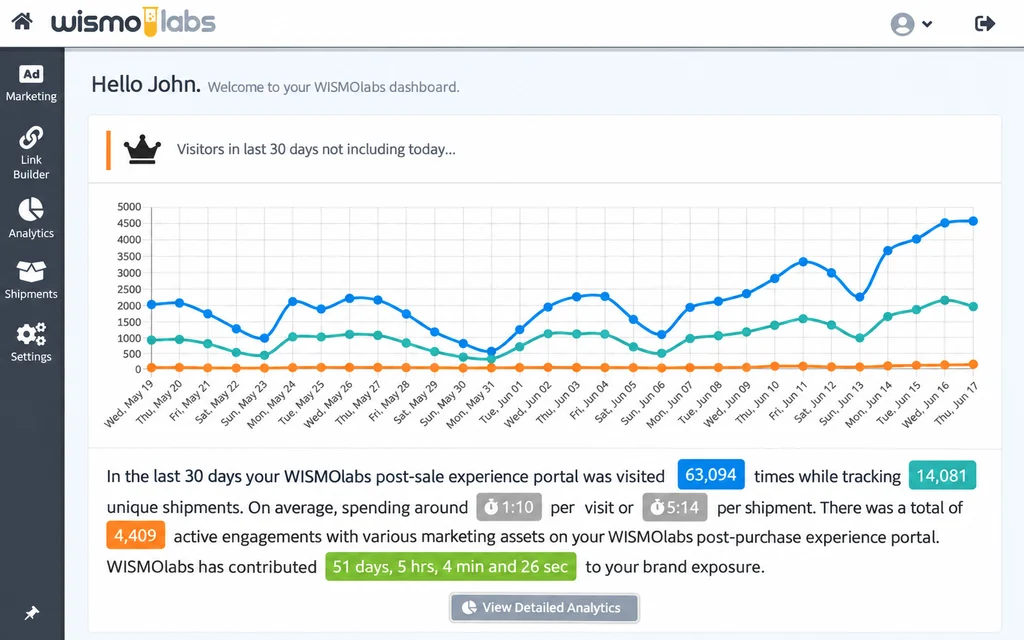
A carrier scan records what happened to the parcel, but it rarely tells the retailer what they should do next. WISMOlabs uses the order details and retailer’s rules to choose a context-aware response. Customer context can change that decision too. Depending on the conditions, the platform may update the branded tracking page or send a delivery message. Cases that meet an escalation rule move into support.
Key features include:
- Tracking and self-service: WISMOlabs turns carrier statuses into a common format and handles handoffs between carriers. It can send a separate update for each parcel when an order is divided into several shipments. Customers see which parcels have arrived and which are still on the way. WISMOlabs receives direct carrier updates or webhooks where available and checks carrier systems when needed.
- Customer notifications: WISMOlabs can send delivery updates by email or SMS. Retailers decide which carrier events should trigger a message, so customers don’t receive repetitive updates that add little information.
- Branded tracking pages: You can set up tracking pages to match your brand identity. They show the current delivery status and can display different content based on the order or customer segment.
- Integrations and connected workflows: WISMOlabs can create tickets in Gorgias or Zendesk and send shipment events to Klaviyo or Attentive. Commerce connectors include Shopify, BigCommerce, Magento and WooCommerce. APIs and webhooks connect custom systems.
- Returns management solutions: The branded portal has configurable workflows, QR codes and shipping labels. It also records return reasons and sends status updates.
- Analytics: Reports include customer engagement, revenue attribution, carrier performance and fulfillment timing.
- AI tools: These help with status normalization, delay prediction or sending shipment context to human reps or external AI tools.
WISMOlabs suits ecommerce brands focused on reducing WISMO tickets and improving post-dispatch communication.
What is parcelLab?
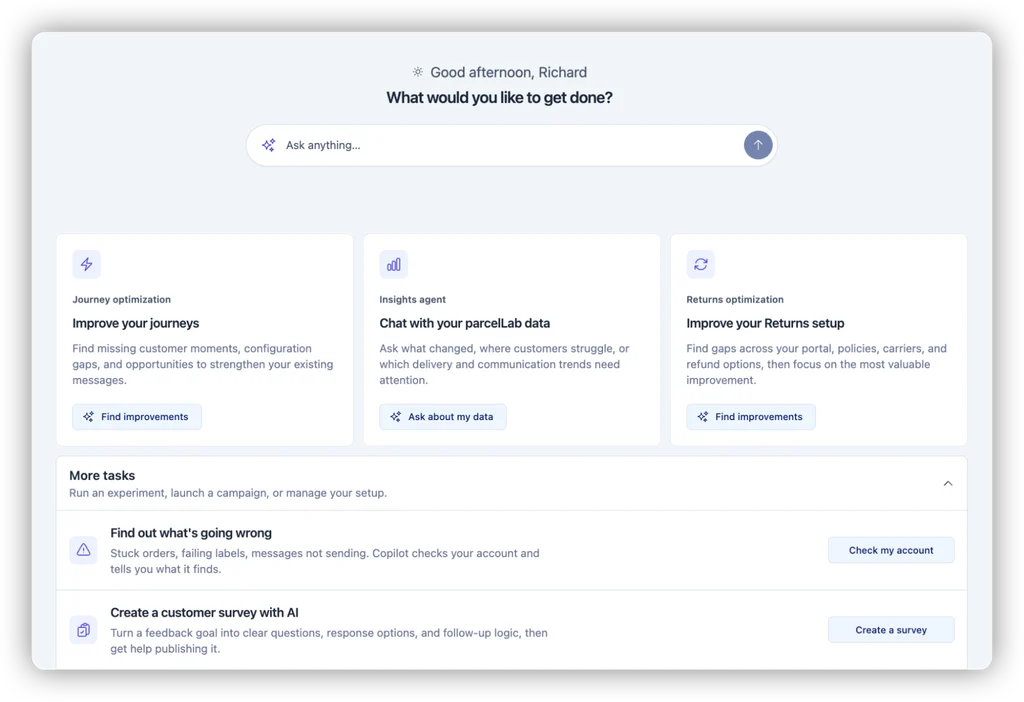
parcelLab covers the entire customer journey, from pre-purchase to post-checkout. The post-purchase platform is built on four pillars: Convert, Engage, Retain, and Insights, all boosted by AI Agents that improve predictions, apply risk scores when choosing return options and answer delivery questions.
- Convert shows estimated delivery dates on product pages and during checkout. It calculates the date and revises the prediction when fulfillment conditions change. This also includes Order Protection, which provides a branded claims process for lost or damaged parcels.
- Engage manages communication after order placement. The Order Status Page can show every parcel from a split order. Customers can check which parcels contain what items. The Messages & Journeys section determines which delivery updates customers receive and when. Journey Manager lets you create communication flows in a visual editor, including A/B testing options. Trending Late identifies shipments that may miss their expected delivery date. Surveys collect customer feedback for future improvement. Dedicated service views also give support agents current order information.
- Retain manages returns according to the rules you set. For example, the portal can automatically offer exchanges or store credit when the customer qualifies. Routing rules determine where returned goods should go, including how items from one order can be returned separately and how international returns are handled. Updates can be sent by email, SMS or WhatsApp. Fraud & Abuse Protection can change the permitted return window or refund method based on risk and the customer’s previous behavior.
- Insights combines logistics and customer engagement data into comprehensive dashboards. You can create custom reports and compare their results with parcelLab benchmarks. Survey data can include things like Net Promoter Score (NPS) and customer sentiment.
The product pillars above share a technical foundation: commerce and CRM systems provide order data, warehouse and carrier systems supply fulfillment updates. parcelLab converts those records into a consistent format, giving each product the same user-friendly order view.
One parcelLab client, Wyze, saw a 20% decrease in WISMO inquiries after it began sending separate updates for parcels in split orders and proactive delay messages. Another, True Classic, reported a 29% increase in revenue per email after introducing a branded order tracking page and proactive delivery and shipment notifications. Book a demo to see what results you can achieve.
parcelLab is a better fit for enterprise retailers and ecommerce brands expanding into more countries or facing greater operational complexity. The combination of delivery estimates, branded tracking and returns gives one place to manage customer communication and return policies.
WISMOlabs vs parcelLab: the full feature comparison
| Feature | WISMOlabs | parcelLab |
|---|---|---|
| Primary use case | Growing ecommerce brands that need branded tracking, clearer delivery communication and self-service returns. | Enterprise retailers and growing brands with complex delivery or return operations across several markets. |
| Regions | Supports international shipment tracking. | Supports operations across several countries, with multilingual communication and market-specific return rules. |
| Carrier integrations | Parcel carriers are included. Data arrives through a direct push or webhook when available. Otherwise, WISMOlabs checks carrier systems at intervals. | 550+ carrier integrations with real-time tracking updates. |
| Tracking page | Branded tracking page on your domain with self-service order lookup. | Branded Order Status Page on your domain, grouping every parcel and its items under one order. |
| Notification channels | Email, SMS or push. | Email, SMS, push or WhatsApp. |
| Split shipments | Sends separate updates for each parcel in a split order. | Shows all parcels and their included items under one order. |
| Returns | Branded portal with configurable flows, QR codes or shipping labels and return status updates. | Configurable return rules, exchanges, store credit and split returns, plus international routing and customs handling. |
| Delivery dates before purchase | Custom delivery date models for enterprise accounts. | Predicted delivery dates on product pages and at checkout, then measures accuracy. |
| Fraud and abuse controls | No customer risk scoring for return decisions is shown. | Customer risk can change the refund method and return window. Higher risk cases can go to manual review. |
| Analytics | Customer engagement, revenue attribution, carrier performance and fulfillment reports. | Logistics and engagement dashboards, custom reports, benchmarks and returns forecasting. |
| AI capabilities | AI delay prediction and shipment data for human or external AI agents. | Copilot answers team questions and Insights Agent explains reports. AI predicts delivery dates and delays, scores return risk and supports the WISMO/R Agent pilot. Agents API connects agents to external systems. |
| Compliance | Security and compliance reviews for enterprise accounts. | SOC 2, HIPAA and GDPR compliance, plus SSO and WCAG 2.1 AA support for the Order Status Page. |
| Implementation | Managed installation and configuration. | Guided implementation with a dedicated manager. Timing depends on scope. |
| Support | Managed onboarding, with dedicated success and technical support on higher plans. | A dedicated customer success manager is supported by implementation and customer engineering teams. |
When to pick which post-purchase experience platform
Company size isn’t enough to decide. Establish the operational problem that creates the greatest cost or customer frustration. Then review how many operational decisions depend on the same order data.
Choose WISMOlabs if
- Questions about delivery status are the main source of avoidable support work.
- The project begins after dispatch.
- Returns mainly require customer registration and label creation.
- Shipment events should connect to the support or marketing tools your team already uses.
- You don’t need delivery estimates before checkout or return decisions based on fraud risk.
WISMOlabs’ main strength is using shipment context to keep customers informed and give support teams a better view of delivery problems.
Choose parcelLab if
- Customers need an accurate delivery estimate before checkout.
- Split shipments should show up as one order, even when they involve several carriers.
- Return options change by country or based on customer history.
- You need help retaining revenue with exchanges or store credit.
- Fraud risk should change the refund method or return window. Suspicious requests should move to a person for review.
- You need advanced AI Agents that answer routine delivery or refund questions using current order data and retailer policies.
- Procurement requires documented security controls and accessibility support.
- You need one place to control customer communication and local return rules across several countries.
parcelLab is the top choice when you’re running a complex system where decisions affect one another. A delay can change the message sent to a customer, and return history can change the options shown in the portal.
What happens when tracking and returns are separate systems?
When tracking and returns are separate, the returns system may see the request without the delivery history, potentially missing that another parcel is still in transit or that the order arrived late. Support then has to check another system before deciding what to do.
The same problem applies to customer history. A return request alone doesn’t show how the customer has behaved in the past. Consider two customers requesting a refund. One has returned nine of the last 12 orders. The other has returned one item in two years. A static return policy could offer both an instant refund, even though the financial risk is different.
parcelLab’s Fraud & Abuse Protection documentation shows how the customer’s risk level, wardrobing tendencies, spend value and fraud category can become conditions in a return rule. The retailer sets the thresholds and decides what each result should trigger. The table below is an example of how this can be set up; the retailer has full control over this.
| Decision | Low or neutral risk | Medium risk | High risk |
|---|---|---|---|
| Refund method | Instant refund | Standard refund | Store credit only |
| Return window | 60 days | 30 days | 14 days |
| Review | Automatic approval | Warning shown and reason required | Manual review |
The commercial risk is measurable. NRF’s 2025 research estimates that 9% of all returns are fraudulent. A single policy can leave margin exposed or add friction to every customer. Risk signals let retailers direct review to the requests that need it.
Separate tools can provide some of this context through integrations, but you still have to pay for separate tools and make sure they connect smoothly with current information. parcelLab keeps tracking and returns records connected so support can see delivery history alongside the request, customer risk determines which return policy applies, and clients can view their order status, reducing customer inquiries.
Which should you choose?
WISMOlabs is a sensible choice for post-purchase tracking and customer messaging. It gives customers clearer shipment updates and reduces routine delivery questions for support.
parcelLab has better tools for complex tasks linked to order data, like AI checkout estimates, tracking, split shipments, returns and fraud controls based on customer history. Retailers operating across several markets gain more control without adding another disconnected system.
Book a parcelLab demo to see what an enterprise-scale post-purchase solution can do for your business operations and customer satisfaction scores.
FAQs
Yes, when your main goal is reducing WISMO tickets through branded tracking and proactive delivery notifications. parcelLab is stronger for improving the full post-purchase journey with delivery estimates before checkout or return decisions based on fraud risk and other complex rules in a branded tracking experience.
Yes. Customers can register a return through a branded self-service portal and receive a QR code or shipping label. Retailers can configure the return flow and collect a reason for each request. WISMOlabs then sends customers updates as the return moves through the process.
Yes. WISMOlabs can track international shipments and follow orders that pass between carriers during delivery. Customers can check the latest status on a branded tracking page and receive updates by email or SMS.
You can prepare for the migration and test parcelLab before your WISMOlabs contract ends, though your agreement determines when you can cancel WISMOlabs. Check the end date and notice period first. Export the data you need and recreate your notification rules in parcelLab. Then run both platforms on a small batch of orders to catch missed or duplicate updates before the full switch.
parcelLab is the better enterprise option when multiple countries and teams need a coordinated post-purchase program. You can easily manage customer communication and return policies across markets and connect to your existing software via APIs.
WISMOlabs serves growing brands that want greater control without a large enterprise rollout. It can work in a tracking project within an enterprise, but parcelLab is better suited to broader enterprise needs.


