…an enterprise retailer in North America needed to switch post-purchase vendors. Nothing about their setup was standardized – no Shopify, nothing simple, everything complex and enterprise-grade.
The dev team scoped the work. Then, they scoped it again because the estimate looked suspiciously easy. They couldn’t believe it would actually be that straightforward. But the work really did take just a couple of days. The entire migration was done within a single sprint.
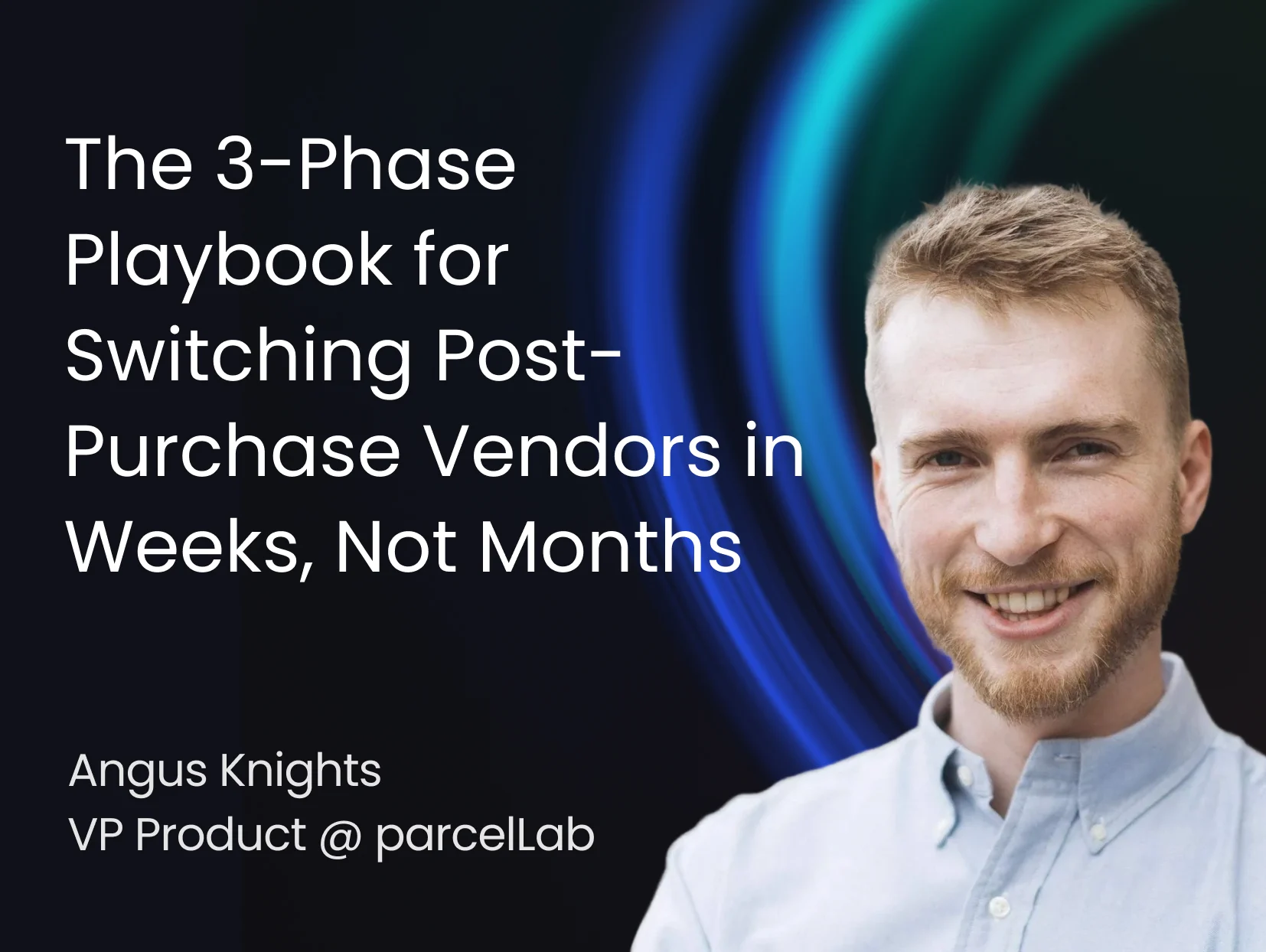
As Angus Knights – VP of Product at parcelLab and the wizard responsible for this magic trick – recalls: “The product manager was like: ‘I’ve never seen anything like this. This was easily within a sprint.”
That story contradicts everything most retailers believe about vendor switching. The common misconception is that changing post-purchase providers means a six-month nightmare of massive internal resource allocation and significant operational risk.
The reality however? The fastest successful migrations happen in about three weeks. “Ha!”, you’ll say, “Not with our super complex setup though.” But what if we told you the secret is not a simpler setup, but a smarter approach?
The expert behind the playbook
Angus Knights has witnessed hundreds of vendor switches from both sides of the table. Before leading product strategy as VP of Product at parcelLab, he ran the Solutions Consulting team – the technical group that works directly with retailers evaluating and executing migrations. That experience revealed clear patterns: what makes switches succeed, what makes them drag on, and why the conventional wisdom about migration complexity is usually wrong.
His core observation: a fast switch is all about the structured approach.
Why the traditional approach fails
Most vendor migration projects follow a predictable trajectory. They’re scoped at two months, then stretch to five or six. Departments argue about priorities. The temptation to redesign everything simultaneously turns a focused migration into a sprawling transformation initiative. Momentum stalls. Enthusiasm fades. Sometimes the project just quietly dies like the trip that never made it out of the group chat.
The fundamental problem is that post-purchase looks deceptively simple from the outside. You send some emails. You show a tracking page. How complicated could it be? Angus paints the reality:
“It’s like the duck, peaceful above the surface, legs frantically paddling below the surface. Because the reality is that a lot of the post-purchase experience is a partnership space. So many different third parties come together.”
Carrier integrations illustrate this hidden complexity perfectly. A retailer might think they’re working with DHL — one carrier, one integration. The reality is far messier.
“The retailer thinks they’re working with DHL, and we’re sitting here thinking, we’ve got 17 integrations with DHL, different aspects. So actually, what’s really happening below the hood? And if your technology provider isn’t helping you to navigate these waters, then they’re pretty treacherous.”
Different service levels run through different APIs. File transfers from 3PLs bundle data for multiple brands that needs to be separated. Data feeds stop without warning or explanation. None of this is visible to the retailer. They just know that their promised two-month implementation is now approaching month six, and they still can’t explain why.
The iterative alternative
The solution isn’t to plan more carefully for a big-bang migration. It’s to abandon the big-bang approach entirely. Angus explains: “Post-purchase experience is the living and breathing part of your whole proposition to the customer. So you need to find a way of making it manageable. It’s like, how do you do five minutes a day rather than two hours in one day and then forget, you know, it’s like practicing any skill. You want to incrementally build on this over time in the smallest steps.”
This mindset shift changes everything about how migrations should be structured. Build a habit instead of a new year’s resolution: Instead of trying to launch with a fully redesigned, optimized post-purchase experience, you start by simply porting what already exists. Then you improve incrementally, building momentum through quick wins rather than betting everything on a distant go-live date.
The 3-phase migration model
Phase 0: Port, don’t redesign
The first phase has one goal: get live with exactly what you have today. No improvements. No redesigns. Just migration. This means establishing the order data flow, which is often reusable from your existing setup. It means building carrier connections, where the vendor’s expertise handles the underlying complexity. And it means porting your existing communications templates directly, HTML and all.
“So everyone’s got their message flows and setups done. There’s a baseline understanding of what they want to send, what information that should have in it, how that should be different for different markets for different carriers. So all of that is the version zero setup. That’s what you would migrate over. But coming up with that in the first instance can take quite some time. They’ve done a lot of work there. I think the key is not to try and redesign all of that.”
The timeline for Phase 0 is measured in weeks, not months:
Order data setup typically fits within a single sprint
Carrier connections are handled by the vendor
Communications QA takes one to two weeks
The entire foundation can be operational before internal stakeholders even start questioning whether the project is on track.
One critical step before going live: establish baseline measurements for your key metrics. This before-and-after comparison becomes essential for demonstrating impact and building internal momentum for continued investment.
Phase 1: Expand your message arsenal
With the foundation in place, Phase 1 focuses on building out your communication capabilities using self-service tools. No dev resources required. This is thinking work, not coding work.
Most retailers run four or five different message types in their post-purchase communications. The most complex parcelLab customers, by contrast, run 40, 50, or even 60. That’s a factor of ten between baseline and what’s actually possible: a backyard compared to a stadium.
The approach is systematic:
→ Analyze the reasons customers contact your service team. → Build targeted messages that address each scenario before it becomes a support ticket. Address validation issues get their own communication flow. → Split orders where part of the shipment arrives before the rest. Packages that get misrouted. Customs delays. Trucks breaking down. Each edge case becomes an opportunity for proactive communication rather than reactive support.
“You want to pick off all of the different reasons for contacts from your customer services team that are still coming in – and understand the context of why or where customers are calling in for those reasons. And then you build targeted communications to kind of respond to each of those different reasons.”
Every new message type chips away at your contact volume while improving the customer experience. And because these are built through self-service tools rather than vendor projects, the iteration cycle is hours rather than weeks.
Phase 2: Connect, automate, personalize
Phase 2 extends post-purchase beyond communications into business system integration and intelligent automation. At this stage, the path diverges based on individual business priorities.
“It starts to diverge more based on what are the priorities for you as a business. Generally, there’s two main angles of attack. One is experience first, and one is revenue first.”
For revenue-first retailers, this might mean segmenting customers and speaking to different groups differently, implementing product recommendations within communications, or building specific flows for frequent purchasers and loyalty members.
For experience-first retailers, the focus shifts to automation around friction points: automatically creating customer service tickets when a carrier scan indicates damage in transit, triggering alerts for shipments stuck in customs, or setting up automatic refunds for missed premium shipping promises.
The specific mix depends entirely on your strategic priorities. There’s no single “right” Phase 2 – only the one that aligns with your business goals.
Phase 3 and beyond: Never done, always improving
Post-purchase is a living system that requires ongoing attention.
“It’s never actually done because things change and evolve in your eCommerce setup.”
Beyond Phase 2, Angus wouldn’t even strictly call them phases anymore.
“It’s more like having a backlog of topics and ideas that you would have business impact against and then basically continuing to iterate on those over time.”
Your carriers will change. Your customer expectations will evolve. New capabilities will become available. The retailers who treat post-purchase as a continuous improvement discipline rather than a one-time implementation are the ones who pull ahead.
What results look like
The first metric retailers notice after switching typically appears within a day: revenue attribution in Google Analytics from customers who visit tracking pages and make additional purchases.
“The first metric that people see is always a revenue number. Always in Google Analytics that shows the revenue impact of the customers who come back to track. That’s always the first number because after a day, there’s something on the scoreboard.”
The improvements can be significant – though Angus admits he was initially skeptical himself before seeing the data. The drivers become logical once you understand them:
→ Embedded tracking pages on your domain eliminate a click from the repurchase funnel and keep customers within your site experience. → More reliable email delivery means more messages actually reaching customers. → Better carrier data means more accurate, timelier communications.
“If you go from less reliable to more reliable, again, if you’re sending 20% more messages and then you’re on an embedded tracking page, that [uplift] suddenly becomes quite understandable. Because you’re actually just sending more communications more reliably and then you’re funneling your customer traffic in a better way.”
What consistently surprises retailers is how much headroom exists beyond their initial expectations.
“A lot of times when we improve or enhance things, we’re pleasantly surprised by how much headroom there is and how much we can actually grow into it. And this is one of those ones where people come in with a certain set of expectations and then often they break through those.”
Some reference points from parcelLab’s experience:
Metric
Observation
Typical message types before optimization
4–5
Message types with mature setup
40–60
Fastest documented migration
~3 weeks
App customer CLV vs. average
20–30% higher
The minimum viable migration team
Successful switches don’t require massive project teams. The minimum dream team includes three roles (tag yourself).
→ Logistics provides support for carrier credentials and connection details. They’re not doing the integration work. The vendor handles that complexity – but they need to provide the access and information required. → IT contributes a minimal but essential piece: the order data switch. This is typically the only development work required, and as the enterprise example demonstrated, it’s often measured in days rather than weeks. → An Experience Owner signs off on communications and owns the customer-facing output. This person might sit in eCommerce, digital, product, customer experience, or even customer service. The title matters less than having someone accountable for the end result.
The pattern that predicts the fastest, most successful migrations is cross-functional ownership – ideally through product management. Angus notes: “Every time we see it owned by a cross-functional product person, we see those solutions get driven really effectively.”
Clear deadlines accelerate everything. Retailers with contract expirations looming execute faster than those with a comfortable runway. Some of the best migrations had real-time pressure:
“I think you need a deadline. I think you need to make this a priority for a period of time. (…) It was like, wow, our contract is expiring so soon with this other vendor. We need to switch like immediately.”
The warning signs for migrations that drag on: nobody actively pushing the project forward, too much time buffer in the schedule, and attempting to redesign simultaneously with migration.
The path forward
The fastest route to a successful vendor switch follows a simple principle: migrate what exists, then improve incrementally. Phase 0 ports your current setup. Phase 1 expands using self-service. Phase 2 automates and integrates based on your priorities. Phase 3 and beyond treats post-purchase as the living system it actually is.
The biggest delays come from the opposite approach – trying to redesign everything simultaneously, turning a focused migration into a sprawling transformation that loses momentum before it delivers value.
The required mindset prioritizes pragmatism over perfection. It uses deadlines as accelerators rather than sources of stress. It trusts the vendor’s expertise to navigate the hidden complexity that lives beneath the surface of every post-purchase implementation. Angus concludes:
“Switching post-purchase vendors is easier than most retailers think. Because there’s a team who’s done this before who will have your back.”
Your questions, answered
The fastest documented switches are completed in approximately three weeks. Even complex enterprise migrations can finish within a single sprint when the focus stays on migration rather than simultaneous redesign.
Order data flow, carrier connections, and a 1:1 port of your existing communications. The principle is simple: don’t reinvent – port what already works, then improve incrementally.
Three roles: logistics support for carrier credentials, an IT advocate for the order data switch, and an experience owner to sign off on communications. Cross-functional PM ownership predicts the fastest projects.
Less than most retailers expect. The order data switch is often completed in days, even for enterprise setups. Carrier integration complexity is handled by the vendor, not your internal team.
The first metric — revenue from tracking page traffic — typically appears in Google Analytics within a day of going live. Retailers consistently report numbers higher than their previous setup.